Key Takeaways
- Three real outcomes: denied boarding, denied entry, or a forced emergency flight purchase at the airport.
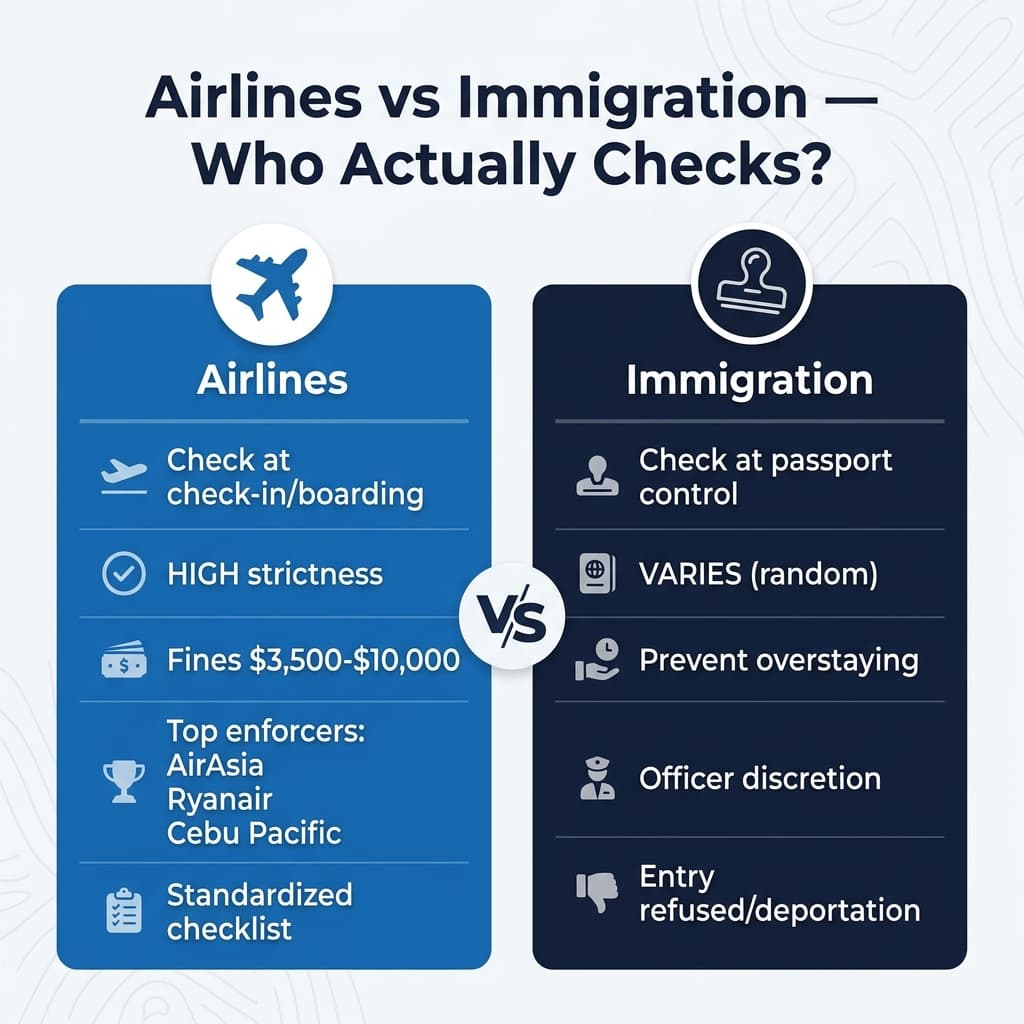
- Airlines (not immigration) catch most failures — budget carriers face per-passenger fines so they enforce aggressively.
- An emergency airport ticket costs $200–$600+; a prepared onward ticket costs $7 — a 30× to 80× difference.
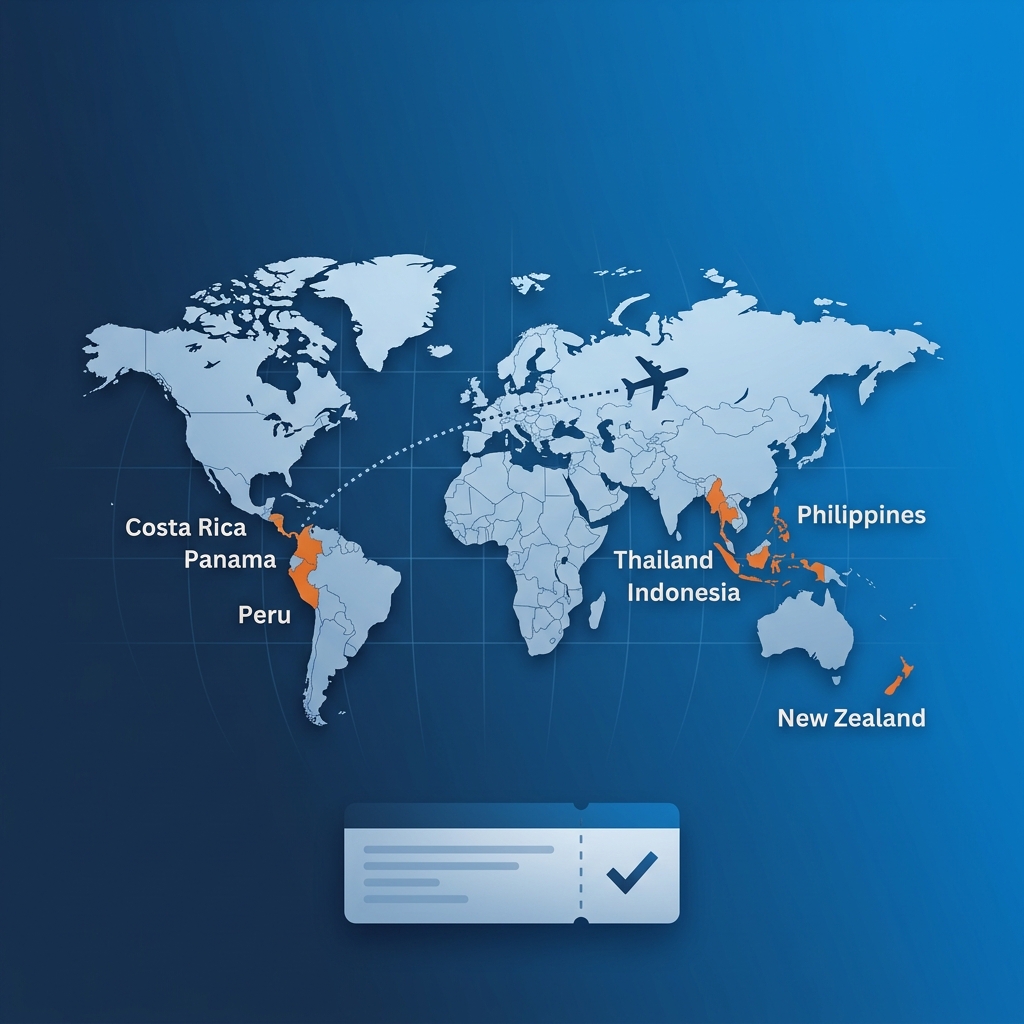
- The Philippines, Costa Rica, Panama, Peru, and New Zealand are the strictest enforcers in 2026.
- An onward ticket with validity from 48 hours up to 14 days solves every one of these scenarios.
Flying to a country that requires proof of onward travel without the paperwork triggers one of three outcomes — denied boarding at check-in, denied entry at immigration, or a forced emergency full-price ticket purchase at the airport. All three waste hours, cost real money, and can end your trip before it starts. This guide walks through each outcome, shows which countries enforce most aggressively, and explains the $7 fix that prevents them.
Without an onward ticket you risk denied boarding, denied entry, or a $200–$600 emergency ticket purchase at the airport. Airlines flying into the Philippines, Costa Rica, Panama, Peru, and New Zealand check almost every passenger. The preventative fix is an onward ticket — $7 one-way, $11 return, $16 multi-city, valid 48 hours up to 14 days — delivered as a verifiable PDF in minutes.
Quick answer — the three outcomes
Three distinct things can go wrong when you do not have proof of onward travel, and which one you hit depends on when the check happens. At check-in, the airline can simply refuse to let you board — they face fines of $3,500 to $10,000 per denied-entry passenger, so they screen hard. At immigration on arrival, the officer can send you back on the next flight (still at the airline's expense, often at yours for the return journey). At the counter, if the airline is willing to board you conditionally, they often require you to buy a full-price ticket out of the country on the spot — typically $200 to $600+ for an immediate booking on the cheapest available exit route.
Outcome 1 — denied boarding at check-in
This is by far the most common failure and happens before you even reach security. The agent pulls up your passport, sees a one-way ticket into a country with a known onward-travel requirement, and asks the routine question: "Do you have proof of onward travel?" If you say no, many airlines will flatly refuse to issue a boarding pass. You are walked out of the queue with your bags, pointed at a nearby airline counter, and told to come back once you have a ticket out.
Budget carriers are the strictest — AirAsia, Cebu Pacific, Ryanair, and Wizz Air have the tightest margins and can least afford the per-passenger fines. Full-service carriers (British Airways, Emirates, Qatar Airways) also check but are more likely to accept a reservation PDF than to demand a ticketed flight. None of them will board you without something to scan.
Outcome 2 — denied entry at immigration
If you get past check-in but arrive at a destination that screens at the border, the immigration officer can refuse entry. This is the worst outcome financially because the airline is legally required to fly you back — usually on their next available flight, which means hours in a holding area, possibly overnight. You keep your onward ticket to the return destination only if your original carrier has capacity; otherwise the airline books you on whatever seat exists.
Countries with high rates of arrival-side refusal in 2026: the Philippines (especially Manila and Cebu), Costa Rica, Panama, Peru, and New Zealand. The officer does not usually escalate if you produce a verified PNR on the spot — but without that, the refusal is automatic.
Outcome 3 — forced emergency ticket purchase
The least catastrophic outcome is also the most financially painful. Some airlines (and some airport immigration desks) allow you to board or enter conditionally, provided you buy a ticket out before you move on. The problem is the price: same-day fares on exit routes range from $200 to $600+, and the longer the gap between check-in and the next possible exit flight, the higher the fare. You end up paying 30 to 80 times what a $7 onward ticket would have cost for the exact same kind of document (a flight reservation with a PNR).
Who enforces most aggressively
Enforcement is not uniform. These are the destinations where travelers consistently report strict airline and/or immigration checks in 2026:
- Philippines — airlines check at check-in on nearly every route; immigration often re-verifies on arrival.
- Costa Rica — dual enforcement (airlines + immigration); flight tickets are preferred over bus tickets.
- Panama — airlines enforce strictly; immigration adds proof-of-funds checks on top.
- Peru — airline checks from US/EU routes are near-universal; Lima immigration screens as well.
- New Zealand — the NZ government explicitly requires onward travel; airlines universally comply.
- Indonesia (Bali) — moderate airline enforcement; Denpasar immigration checks on VOA arrivals.
- Thailand — budget airlines (AirAsia, Thai Lion) enforce; full-service less consistently.
For the complete, regularly-updated country list see our 2026 enforcement guide. If you are flying specifically to one of the strict five, our programmatic country guides explain airline-by-airline what to expect.
$7 fix vs $200–$600 emergency — comparison
The economic case for pre-ordering an onward ticket is almost absurdly clear. Here is the cost side by side:
At an average 30× to 80× cost ratio and a near-zero time cost to prepare, the math is uncontested. For a full walkthrough of each method — free workarounds included — see our 7 methods guide.
Frequently asked questions
Will the airline really refuse to board me?
Yes — with significant frequency on strict routes. Budget carriers face $3,500–$10,000 per-passenger fines if they carry someone refused entry, so they enforce proactively. Reports of denied boarding on Philippines, Costa Rica, and New Zealand routes are routine in traveler forums.
Can I just show a hotel booking instead?
Not reliably. Hotel bookings indicate intent to stay, not intent to leave, which is what the onward-travel requirement is about. Immigration and airlines specifically ask for a flight ticket or reservation.
What if I'm flying home via a connection — is my main return ticket enough?
Yes. If you have a confirmed outbound ticket that leaves within your authorized stay, that satisfies the requirement. The issue only arises when you have a one-way ticket and no planned exit.
Can I argue my way through with the right explanation?
Sometimes, rarely, with supplementary evidence (a detailed itinerary, a visa stamp, a flight held for a later date). But it is a coin flip — the agent has to escalate, supervisors need to intervene, and you need a stressful 30-minute conversation at check-in. A $7 onward ticket is the decisive, no-argument solution.
If I'm already at the airport without proof, what's the fastest option?
Order an onward ticket on your phone right at the counter. Delivery is typically within minutes, and the 48-hour validity window starts the moment the PNR issues — plenty of time for check-in and immigration on the other side. See our quick explainer or go straight to order now.
Onward Ticket
Verified AuthorTravel Documentation Expert at OnwardTicket.us
Helping 3,455+ travelers navigate onward travel requirements, visa documentation, and immigration processes.
6 articles published